
Trended Data Good for Super Bowl Predictions and Consumers

by Kerry Rivera 3 min read January 25, 2016

football-blog-post-image

Who will take the coveted Super Bowl title in 2016? Now that we’re down to the final two teams, the commentary will heighten. Sportscasters, analysts, former athletes, co-workers … even your local barista has an opinion. Will it be Peyton Manning’s Denver Broncos or the rising Carolina Panthers?

Millions will make predictions in the coming weeks, but a little research can go a long way in delivering meaningful insights.

How have the teams been trending over the season? Are there injuries? Who is favored and what’s the spread? Which quarterback is leading in pass completions, passing yards, touchdowns, etc.? Who has been on this stage before, ready to embrace the spotlight and epic media frenzy?

The world of sports is filled with stats resulting from historical data. And when you think about it, the world of credit could be treated similarly.

Over the past several years, there has been much hype about “credit invisibles” and the need to “score more.” A traditional pull will likely leave many “no-file” and “thin-file” consumers out, so it’s in a lender’s best interest to leverage alternative scoring models to uncover more.

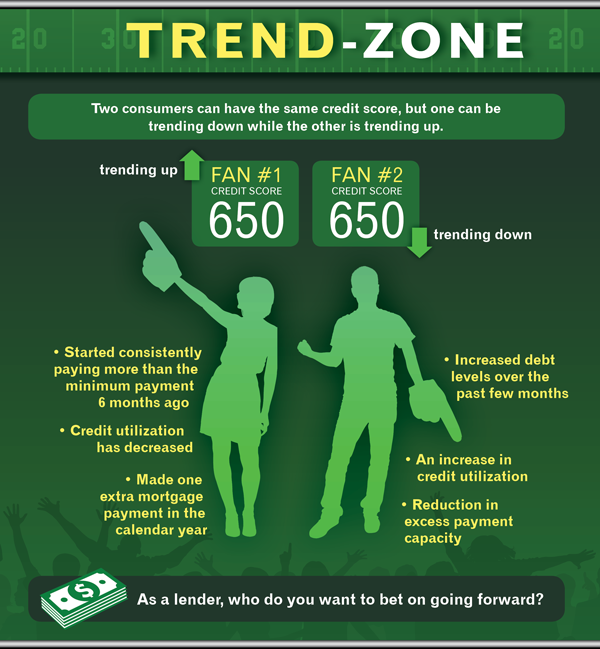
But it’s also important to remember a score is just a snapshot, a mere moment in time. How did a consumer arrive to that particular score pulled on any given day? Has their score been trending up or down? Has an individual been paying off debt at a rapid pace or slipping further behind?
trend-zone-01b

Two individuals could have the exact same score, but likely arrived to that place differently.

The backstory is good to know – in sports and in the world of credit.

Trended data can be attached to balances, credit limits, minimum payment due, actual payment and date of payment.

By assessing these areas on a consumer file for 24 months, more insights are delivered and lenders can take note of behavior patterns to assist with risk assessment, marketing and share-of-wallet analysis.

For example, looking closer at those consumers with five trades or more, Experian trended data reveals:

  • 27% are revolvers, carrying balances each month
  • 27% are transactors, paying off large portions, or all of their balances
  • 9% are rate surfers, who tend to frequently transfer balances to credit cards with 0% or low introductory rates.

Now these consumers can be viewed beyond a score. Suddenly, lenders can look within or outside their portfolio to understand how consumers use credit, what to offer them, and assess overall profitability. In short, trended data provides a more detailed view of a borrower’s historical credit performance, and that richness makes for a more informed decision.

Without a doubt, there is power in the score – and being able to score more – but when it comes time to place your bets, the trended data matters, adding a whole new dimension to an individual’s credit score. Place your wagers accordingly.

As for who will win Super Bowl 2016? I haven’t a clue. I’m more into the commercials. And I hear Coldplay is on for the half-time show. If you’re betting, best of luck, and do your homework.


Related Posts

Ask the Expert: The Future of Lending Starts With Identity With Shawn Rife and Brian Cardona

Identity intelligence and alternative data can help lenders validate consumers and support more informed decisions across the customer lifecycle.

September 16, 2026 by Julie Lee
Financial Institutions Are Rethinking Customer Acqusition

Customer acquisition strategies are constantly evolving toward more precise targeting. From a marketing lens, you can track every step, optimize communication channels and still miss the person most likely to convert. Attribution can tell us which channels work and automation can make marketing spend more efficient. But both assume we know who is actually on the other end. Financial institutions are learning that finding audiences and targeting them is no longer the biggest challenge. As acquisition optimization marketing becomes more sophisticated, teams can measure and act on more signals than before. What they can't always know is whether the person on the receiving end is real. Customer acquisition has evolved into an identity problem. The challenge is not that every questionable signal represents malicious activity. It's that acquisition systems must make increasingly intelligent decisions with an imperfect understanding of who they're actually engaging. When identities are fragmented, duplicated, temporary or synthetic, optimization becomes a question of trust as much as targeting. When your signals don't reliably identify customers The customer journey often includes searching, filling out a form, creating an account, requesting a quote and subscribing. All of these signals work well when identity is relatively stable.  However, financial institutions are finding that these signals are becoming less reliable. A single person can operate across multiple personas, devices, browsers, aliases, accounts and intermediaries while several apparent “people” may actually represent one underlying actor. Financial instituions are finding: Fragmented customer signals Difficulty distinguishing an old account from a new one Different digital pathways associated with the same individual Signals that are generated by automation Real customers getting flagged because signals are too thin to evaluate confidently Legacy signals continue to be challenged Marketing has historically treated intent as a valuable signal because intent was relatively difficult to produce. A search required human intent. A form required someone to fill it out. An inquiry implied a meaningful amount of human effort. Financial institutions are already combating AI-enabled fraud, and now marketing teams are starting to face it on a massive scale. AI can mimic human behavior by researching products, comparing prices, filling out forms, creating accounts and signing up for services. A valid email address is no longer enough. Marketers need to know: How long has it existed? How recently has it been active? Does its activity appear consistent or suddenly anomalous? Has it gone dormant and returned? Is it associated with patterns that suggest stability or unusual behavior? How to build on your strongest signal Email remains one of the most persistent identifiers in digital commerce, following people across devices, platforms, transactions, subscriptions, accounts and years of activity. For over two decades, this has shaped how AtData thinks about identity. Now, as part of Experian, it’s shaping how an entire platform and team approach identity. A marketer doesn’t need every prospect to have existed online for twenty years. But understanding whether a newly acquired prospect has meaningful identity context can dramatically improve the quality of the decision being made around it. Better identity intelligence can help organizations reduce unnecessary friction by improving their ability to recognize legitimate customers. With a strong identity foundation, marketing teams can better address: Which audiences are more likely to convert? Which leads are high quality? Which channels are driving incremental growth? What do the best prospects look like? The value isn't simply having an email address. It's understanding the history and behavioral context associated with it. That context can provide a stronger digital identity signal, helping marketers understand how long they have been active, whether its behavior is consistent with that of a real person and whether current activity aligns with past patterns. It continues to be one of the most persistent identifiers in digital commerce. An infrastructure built for what's coming The acquisition of AtData by Experian reflects a fundamental shift in how identity infrastructure needs to work. Experian's scale and decisioning capabilities, combined with AtData's real-time email intelligence, create a strong platform. Read more about the why behind the acquisition and see how email works as an identity anchor for fraud prevention. Contact us to learn about our customer acquisition solutions

September 15, 2026 by Zohreen Ismail
As Electric Vehicle Adoption Eases, Dealers Can Find New Opportunities To Reach Consumers

After years of rapid growth, new electric vehicle (EV) registrations have moderated, and the EV market has entered a new chapter. But slower growth shouldn’t be mistaken for disappearing demand, with data suggesting the reality is much more nuanced. According to Experian Automotive’s Automotive Consumer Trends Report: Q2 2026, battery EVs accounted for 8.21% of new retail registrations in the last 12 months, down from 9.23% a year earlier. However, consumers aren’t simply walking away from electrification. In fact, more than one million new EVs were registered during the past 12 months and the used EV market recorded more than 540,000 registrations over the same period. The opportunity may be less about waiting for the EV market to grow and more about understanding where EV demand is present, who is driving them, and how to reach those consumers more effectively. Who is likely to purchase an EV and what vehicle types are they interested in? Understanding who’s in the market for an EV can allow dealers to position themselves around consumers’ needs as they choose a vehicle that fits their everyday lifestyle. In the second quarter of 2026, Millennials and Gen X accounted for 67.83% of new EV registrations, nearly 10 percentage points above their combined share of all new, retail registrations. Millennials were also the largest generational audience across both new and used EV market share, coming in at 35.76% and 38.42%, respectively. It’s important to consider that the EV shopper isn’t necessarily looking for an unfamiliar or new type of vehicle. In many cases, they’re seemingly looking for an electric version of the practical vehicle they already know. For instance, SUVs accounted for 77.47% of new EV registrations in Q2 2026, which was similar to SUVs’ 63.49% share of all new retail registrations. For these shoppers, creating messaging around value, practicality, and available choices may resonate differently than premium technology messaging aimed at some new-EV prospects. The more precisely dealers can identify those audiences, the less they need to depend on broad EV market momentum to generate demand. To learn more about EV insights, view the full Automotive Consumer Trends Report: Q2 2026 presentation.

September 15, 2026 by Kirsten Von Busch

Subscribe to our Newsletter

Enter your name and email for the latest updates.

This site is protected by reCAPTCHA and the Google Privacy Policy and Terms of Service apply.

Subscribe to our Newsletter

Don't miss out on the latest industry trends and insights!
Subscribe