
Loading...

The Demand for Electric Vehicles Boils Down to the Right Market

Published: October 31, 2018 by Brad Smith

Depending on who you talk to, the electric vehicle (EV) market will significantly impact the automotive industry for years to come. There are some industry pundits who wholeheartedly believe EVs have altered consumer buying behavior, while others believe the trend is drastically overstated. Two very contrasting opinions.

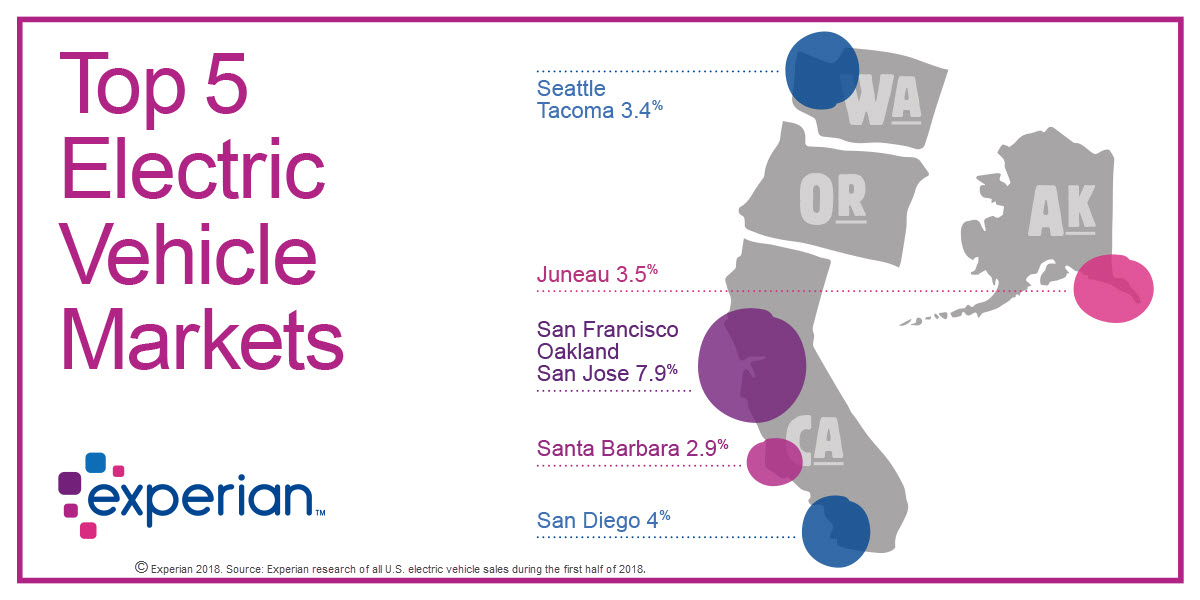
The reality is, both can be right – it just depends on perspective. And frankly, it comes down to geography. While EV market share for the entire country during the first half of 2018 was only 0.9. percent, 3.6 percent of all new registrations in California were EVs. If we dig a bit deeper, the blossoming vehicle segment made up 7.9 percent of the San Francisco/Oakland market.

In fact, six of the top 10 DMAs* for EV market share are in California and not a single top 10 DMA is east of the Rocky Mountains. By comparison, EVs may seem somewhat of a myth in the Midwest. The only DMAs east of the Mississippi River cracking the top 20 for EV market share are Charlottesville, Virginia, Washington D. C. and Atlanta.

Top 10 DMAs by Electric Vehicle Market Share

  • San Francisco, Oakland, San Jose: 7.9% share
  • San Diego: 4% share,
  • Juneau: 3.5% share,
  • Seattle Tacoma: 3.4% share
  • Santa Barbara: 2.9%
  • Monterey Salinas: 2.9%
  • Los Angeles: 2.8% share
  • Honolulu: 2.2% share
  • Portland: 2% share
  • Sacramento, Stockton, Modesto: 1.8% share
Local Market Knowledge Key to Success With EVs

At the end of the day, are there specific implications for dealers and manufacturers? It comes down to understanding the local market to determine how much emphasis should be placed into EVs. Some in the industry may not view Juneau, Alaska as a hotbed for EVs, but the data tells a different story.

Dealers and manufacturers cannot rely solely on “feel” and “pre-conceived notions.” They need to dig deep into the data to make the right decisions. It’ll provide a better sense of where they can focus inventory, as well as marketing campaigns.

*DMA® is a registered service market of The Nielsen Company. Used under license.

Related Posts

Many across the industry have been waiting to learn how EV activity has changed now that the EV tax credit has been eliminated. According to Experian’s State of the Automotive Finance Market Report: Q3 2025, the EV market saw a sharp uptick in transactions as many locked in these benefits before they disappeared, though it remains to be seen what the market will look like in the fourth quarter. With the EV market expanding and more models entering the lineup, shoppers also benefited from various options across a wider range of price points within their budget. Even so, many opted to lease a new EV rather than purchase it. More than 56% of consumers leased an EV in Q3 2025, up from 46.43% last year. The gap between the number of EV leases and purchases reflects several underlying factors, one of them being this option likely offered lower upfront costs and monthly payments. For instance, the average monthly payment for a lease was $172 lower than a loan for an EV in Q3 2025. Where EV performance stands in the broader market When looking at the data from a larger perspective, EVs made up 25.31% of the total new lease market, compared to 17.69% a year ago. The alternative fuel type also comprised four of the top ten leased models, with Tesla Model Y (4.35%) and Tesla Model 3 (2.58%) as the top two. They were followed by the Honda Prologue (1.78%) as the fifth most leased model and the Hyundai IONIQ 5 (1.49%) as the ninth. EVs making up nearly half of the top ten leased models in the overall market underscores how quickly consumer preferences can shift and how incentives play a role in purchasing behavior. Consumers’ comfort with EV technology continuing to grow paired with the steady expansion of compelling models across segments also highlights the momentum that is being brought to the overall automotive industry. As the market continues to move forward, the interplay of expiring incentives, more model availability, and a strong desire for leasing shows how EVs have steadily become a more prominent consideration. Leveraging these insights will help automotive professionals best position themselves to support consumers navigating an increasingly dynamic landscape. To learn more about EVs and other automotive finance trends, view the full State of the Automotive Finance Market Report: Q3 2025 presentation on demand.

Published: December 4, 2025 by Melinda Zabritski

Experian Automotive Series | What Auto Marketers Are Prioritizing in the Second Half of 2025 As we close out our four-part series on what auto marketers are prioritizing in the second half of 2025, we’re shifting gears from strategy to execution. It’s time to explore how marketers are operationalizing data, seeking clarity, and building emotional connections that deepen relationships with customers. With the end of the year’s competitive automotive landscape, clarity and connection aren’t just buzzwords—they’re the cornerstones of growth and loyalty for 2026. Let’s start by exploring how clarity empowers today’s marketers to steer their strategies with control. Clarity: Putting marketers in the driver’s seat Data-guided auto marketers who leverage data insights have a clearer understanding of where consumers are on their car-buying journey. You can learn whether car buyers are gearing up for: A longer commute and want an electric vehicle (or a hybrid vehicle).1 Expanding their family and want a top-tier safety rating with cargo space. Factoring in market trends and wanting to be more economical.2 Creating a new and loyal customer base requires dealers, marketers, and OEMs to focus on clarity and connection. This will be more relevant than ever in the final days of 2025. Gone are the days when dealers and agencies used platforms and tools they did not understand. More businesses are simplifying their services and products by offering guides, Artificial Intelligence (AI) tools, tutorials, consultants, and webinars. At Experian Automotive, we're here to do just that, bringing clarity to our auto solutions, such as the Experian Marketing Engine (EME). While the EME tool has robust and dynamic data, two of our most widely used features — AutoAudiences and AutoInsights — stand out for their impact. Let’s break them down in the simplest way: AutoInsights helps marketers define where, what, and how. AutoAudiences helps reach who to target and when they might be in the market. For further clarification, savvy marketers leverage AutoInsights to strategize and understand their market, then activate AutoAudiences to curate marketing opportunities. With these tools empowering clarity, it’s equally important to focus on building genuine connections with car shoppers. Connection: Personalized experiences that drive sales Building a strong connection starts by truly understanding what consumers need and where they are on their car-buying journey. It’s important to know how consumers plan to use their vehicle and how they have serviced their cars in the past (or how they plan to service them in the future). By focusing on these details, marketers and dealerships can create more meaningful relationships and deliver helpful, relevant experiences that customers value. On the journey to better connections, consider your customers’ communication preferences, 2026 plans, and affordability.3 “Human connection...separates good stores from great ones,” notes Dealer Principal, Matt Birckhead at Sir Walter Chevrolet4 , while General Manager, Michael Wood at Jaguar Land Rover Virginia Beach collaborates with his Digital Director, Ryan Montville, to generate vehicle specs and feature descriptions that connect emotionally with target buyers 5 Key Takeaway: Automotive marketers who leverage data-informed clarity and authentic customer connection are best positioned to drive growth and loyalty in the final days of 2025 into 2026. By using innovative tools like Experian Marketing Engine, focusing on consumer needs, and personalizing every interaction, dealerships, agencies, and OEMs can optimize campaigns and foster lasting relationships. Mastering clarity with data and building emotional connections are the keys to success in automotive marketing today. Ready for clarity and connection with Experian data? Lead the way in creating customer-first experiences that fuel long-term growth. Connect with Experian Automotive and start driving measurable impact. Learn More https://www.coxautoinc.com/insights-hub/q3-2025-ev-sales-report-commentary/ https://www.experian.com/automotive/auto-credit-webinar-form https://news.dealershipguy.com/p/inside-q4-s-new-vehicle-trends-and-how-dealers-are-adjusting-2025-10-28 https://news.dealershipguy.com/p/one-price-vs-negotiation-what-four-operators-say-really-builds-trust-and-gross-2025-10-16 https://news.dealershipguy.com/p/5-powerful-chatgpt-hacks-car-dealers-are-using-to-supercharge-their-business-insights-2025-09-19

Published: November 11, 2025 by Chanté O’Neill

While the dynamics of the electric vehicle (EV) market continue to drive headlines, recent data reveals that although EV registrations remain steady, hybrids are becoming a practical bridge between gas-powered vehicles and EVs. Experian’s Automotive Consumer Trends Report: Q2 2025 found EVs accounted for 9.2% of new retail registrations, down from 10.5% in Q2 2024, and gas-powered vehicles declined from 73.7% to 71.9% year-over-year. Meanwhile, hybrids jumped from 15.8% to 18.9% in the same time frame. Digging a bit deeper, one of the most telling insights from the data was the apparent transition that consumers make when returning to the market for another vehicle purchase. The data shows that as consumers become familiar with alternative fuel types, some “graduate” into more electrified vehicles. For example, nearly 13% of gas-powered vehicle owners replaced their vehicle with a hybrid (10.8% for hybrids and 2.0% for plug-in hybrids [PHEV], respectively). Meanwhile, 52.2 % of hybrid owners returned to the market to purchase another hybrid and 5.0% returned to purchase a PHEV.  Further along in the electrified vehicle funnel, we’re seeing 11.0% of PHEV owners returning to market to purchase a hybrid, while 31.7% returned to purchase another PHEV and 22.2% purchase an EV. Most EV households are not exclusively electric Data in the second quarter of this year found 80% of EV-owning households also have a gas-powered vehicle and 14.9% also own a hybrid, demonstrating that consumers are looking for ways to accommodate their diverse driving needs. While the interest in EVs remains strong, many consumers still rely on more traditional fuel types for various reasons. Though, hybrids are notably becoming a middle ground solution as they offer fuel efficiency without the other concerns that can accompany an EV. As alternative fuel types continue to create a household name in the automotive industry, hybrids are starting to play a notable role in the transition to electrification. Data from this quarter not only shows that consumers are experimenting with alternative fuel types, but they’re also integrating them into multi-vehicle households. With their growing popularity reflects a pragmatic approach to balancing the latest innovation with everyday practicality, hybrids may be the key steppingstone that brings mainstream consumers closer to the electrified space. To learn more about alternative fuel type insights, view the full Automotive Consumer Trends Report: Q2 2025 presentation.  

Published: September 16, 2025 by Kirsten Von Busch

Subscribe to our Auto blog

Enter your name and email for the latest updates.

This site is protected by reCAPTCHA and the Google Privacy Policy and Terms of Service apply.