
Vehicle Detail Pages with a Free Vehicle History Report Have Higher Lead and Sale Conversion Rates

by Kirsten Von Busch 3 min read March 15, 2022

Woman shopping for a vehicle with a vehicle history report

We recently collaborated with our integration partner, TrueCar, to analyze vehicle history data’s impact on online listings. We analyzed millions of records over months of data and matched online listings to DMS sales to confirm closing rates.

The short story – dealership Vehicle Detail Pages (VDPs) on TrueCar.com that offer consumers a Free Experian AutoCheck vehicle history report had a higher lead conversion rate. We expected the data to confirm that VDPs with a Free VHR would have a higher lead conversion rate. However, we uncovered additional insights that even surprised us!

The most common search filter

Consumers value transparency from a dealership and expect to be informed if a vehicle they are looking at has been in an accident. We learned from the study that when consumers used vehicle history data to filter their user’s search results, the “accident” filter was the most common vehicle history data filter used. More than one-third of consumers using vehicle history data to filter search results use “accident” as a filter criterion.

Why is this important? There are over 280 million vehicles in operation, and four out of ten of those vehicles have been in an accident. That means more than 100 million vehicles on the road have been in an accident—and 20% of vehicles on the road have had multiple events.

Higher conversion rates (with a twist)

Having been in the automotive data and analytics space for years, we were not surprised that the analysis continued to support our previous research that vehicle detail pages with a free vehicle history report have a higher lead conversation rate!

Things started to get even more interesting, though: VDPs with a free AutoCheck VHR converted at a 27% higher rate. That holds true if the VDP page had a Free AutoCheck report available to the consumer, but if the consumer clicked on the free AutoCheck vehicle history report to view the details of the information, the lead conversion rate jumped to 318% (no, that’s not a typo). The lead conversion rate increased to 318% if the consumer viewed the AutoCheck vehicle history report!
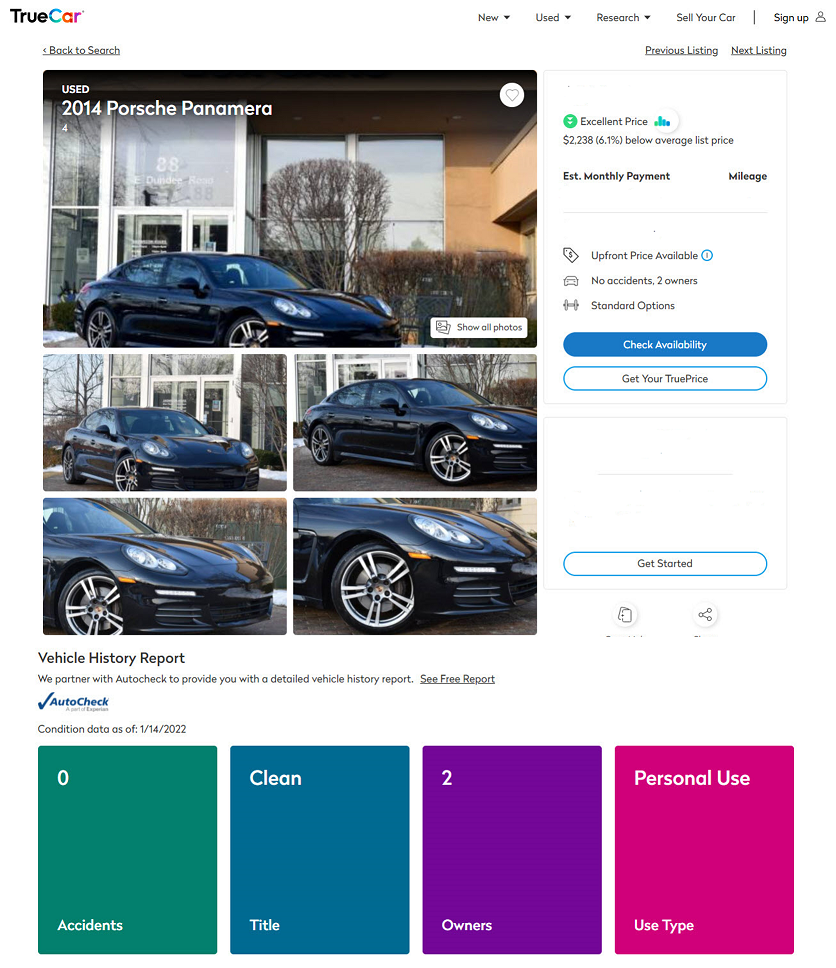
TruCar AutoCheck vehicle history detail page

VDP sale conversion rates

And while we all appreciate a good lead conversion success story, we also wanted to analyze sale conversion rates. We learned that TrueCar VDPs that offered consumers a Free AutoCheck vehicle history report on behalf of a dealership had a higher sales conversion rate. Not only is the rate higher—the sale conversion rate is 50% higher for VDPs that offer a free VHR.

Here are a few more interesting pieces of information we uncovered with this latest analysis:

  • VDP’S without an accident close at about 200% higher than those with an accident
  • Vehicles without frame damage had a 250% greater close rate
  • Vehicles without a salvage indicator had a 634% greater close rate

Consumers want to make informed decisions when purchasing vehicles, and automotive dealerships can help by providing them with a free AutoCheck Vehicle History Report on every Vehicle Detail Page. Help improve lead conversation rates, sale conversation rates, and build customer trust by offering vehicle history transparency.

For dealers with an AutoCheck subscription, you can activate your vehicle listings for free on TrueCar by calling AutoCheck Customer Service at 1 888 409 2204.

Dealers interested in learning more about the benefits of becoming an AutoCheck subscriber, contact us today!


Related Posts

AI Agent Identity Verification: How to Verify AI Agents in Digital Transactions

AI agents are changing the way consumers interact with businesses online. Learn how you can establish greater confidence in AI transactions.

August 26, 2026 by Laura Burrows
Ask the Expert: How Alternative Data Turns Insight into Advantage

What if some of your best potential borrowers are the ones your traditional credit strategy can't fully see? A credit score can tell lenders a lot about a consumer, but it doesn't always capture the full picture of how someone is managing their financial life. For consumers with nontraditional income patterns or limited credit histories, that incomplete view can mean missed opportunities. In this Ask the Expert session, David Elmore of Experian talks with Michelle Goeppner, Chief Lending Officer at Vantage West Credit Union, about how alternative data can provide additional context around consumer risk, uncover opportunities traditional data alone might miss and help lenders expand their reach without disrupting strategies that already work. Who could lenders be missing? That question is especially important when a consumer’s financial life doesn’t fit neatly into a traditional credit profile. Take gig workers. Someone driving for Uber or delivering for DoorDash likely has a different income pattern than a salaried employee — irregular, seasonal, spread across platforms. That doesn't mean they aren't reliably managing bills, rent and other obligations. It just means a traditional file may not show it. Goeppner has a name for the risk of overlooking that context: FOMM — Fear of Missing Members. You've heard of FOMO — Fear of Missing Out. I think about it as FOMM — Fear of Missing Members. Who are we leaving behind if we're not using it?Michelle Goeppner, Chief Lending Officer For credit unions especially, that's not just a data question — it's a mission question. A partial view of a member's finances can mean missing a member the institution exists to serve. The credit score alone doesn't tell you where someone's headed Traditional credit data is still  foundational to lending decisions. But alternative data — income, cash flow, payment behavior — adds a layer that a credit score alone can't provide. Goeppner illustrates the distinction with two consumers who have exactly the same credit score: I don't know if you're a 640 score on your way to 720 — or are you a 640 headed southwards to 580? It doesn't show me how you're managing your day-to-day financial lifeMichelle Goeppner, Chief Lending Officer Two borrowers can share the same score and be moving in opposite directions. Alternative data helps lenders tell the difference — and put that score in context rather than treating it as the whole story. Start small and layer it in Adopting alternative data doesn't mean overhauling an existing strategy. As Goeppner puts it, it's additive, not a replacement: It's not a rip and replace. You don't have to let go of your existing playbook. It's additive — you layer it in.Michelle Goeppner, Chief Lending Officer Her advice for getting started: Define the problem first. Are you trying to increase approvals, reach more underserved borrowers, or improve decisioning for a specific product? Test before you scale. Revisit loans you've already booked and ask whether alternative data would have changed the outcome — or pilot it on a single product before rolling it out further. Build in governance from day one. Document what changed, where the new data was used, and what results followed. As Goeppner puts it: “Crawl, walk, run. Slow and grow.” More loans without changing the risk profile For Vantage West, the value of that approach has shown up in its lending results. It has been an absolute game changer for us at Vantage West. We have been able to make more loans to our target members, our target segments, without changes to our risk profile.Michelle Goeppner, Chief Lending Officer That distinction matters. The goal isn't approving more loans for its own sake — it's having enough information to recognize good borrowers that traditional data alone would have missed. The result is a fuller picture of the people behind the credit file, and more confidence in deciding who a lender can serve. Explore alternative data with us Alternative data can help lenders add context to traditional credit information for a more complete view of consumers. Experian works with institutions of all sizes to incorporate additional consumer signals into existing lending strategies — strengthening decisioning, managing risk and identifying new opportunities for growth. Learn more Contact us About our experts Michelle Goeppner Chief Lending Officer, Vantage West Credit Union Michelle Goeppner is a dynamic financial services executive with over two decades of experience driving strategic growth, product innovation, and operational excellence across leading credit unions and financial institutions. Currently serving as the Chief Lending Officer at Vantage West Credit Union, Michelle leads the strategic vision for multi-billion-dollar consumer loan and deposit portfolios, as a member of the Executive Coalition. Her expertise spans consumer lending, product management, integrated marketing, and talent development, with a proven track record of leveraging fintech partnerships, automation, and data-driven strategies to optimize portfolio performance and member engagement. Throughout her career, Michelle has held pivotal leadership roles in organizations such as Alliant Credit Union and Discover Financial Services. She is recognized for her collaborative approach, detail-oriented execution, and commitment to developing future female leaders. Michelle’s contributions include founding Alliant’s Women’s Resource Group, serving on advisory councils and boards, and earning multiple industry awards for excellence and innovation. She holds an Executive Certification in Product Management from UC Berkeley, a Master of Science in Integrated Marketing Communications from Roosevelt University, and a Bachelor of Science in Marketing from Northern Illinois University. David Elmore Vice President of Fintech Sales, Experian David Elmore leads a team of fintech sales professionals at Experian focused on helping fintech organizations drive responsible, scalable growth through data-driven analytics and decisioning. With more than 20 years in financial services — a decade of it focused on fintech — he brings deep expertise in applying traditional and alternative data across the customer lifecycle. David and his team partner with fintech leaders to navigate opportunities across acquisition, underwriting, portfolio management, and collections, balancing innovation, risk, and trust.

August 26, 2026 by Julie Lee
Scam Detection 101: How to Spot Scam Schemes Before Customers Fall Victim

Explore five common scam schemes, the signals to watch for and how fraud teams can enhance scam detection.

August 25, 2026 by Laura Burrows

Subscribe to our Newsletter

Enter your name and email for the latest updates.

This site is protected by reCAPTCHA and the Google Privacy Policy and Terms of Service apply.

Subscribe to our Newsletter

Don't miss out on the latest industry trends and insights!
Subscribe