Credit Lending

Smaller creditors often struggle to access reliable credit‑reporting solutions, as many available options frequently require technical integration, such as full Application Programming Interface (API) implementation or enterprise‑level approvals, creating barriers that small lenders cannot easily overcome. Minimum volume requirements further intensify the challenge, forcing smaller creditors to pay disproportionately high costs for the limited number of reports they need. As a result, the financial burden and operational complexity restrict their ability to compete, hindering growth and preventing them from adopting the same efficient, data‑driven processes available to larger institutions. Experian fully recognizes the need to empower smaller creditors and is proud to introduce a new capability, Experian Express, designed with these creditors in mind. Experian Express is a digital onboarding portal that fast-tracks the credentialing process for smaller creditors to gain access to Experian’s Credit Profile Report for the purpose of extending credit. Via a fully digital online process, users can choose from two plans tailored to the needs of community banks and credit unions. A new opportunity to build high-value relationships With Experian Express, credit unions and community banks can offer benefits to both consumer and business customers seeking access to credit. Consumers and businesses want more digital convenience, and a primary institution that can meet their needs in one place, as more than half of consumers who switch their primary bank hold over four checking relationships¹ and 55% of U.S. consumers say mobile apps are their most‑used method for managing bank accounts,² while customers across all age groups are curating financial services from multiple providers due to digital gaps at their primary institutions.³ Community banks and credit unions that offer integrated digital credit products, faster onboarding, and personalized advice can convert today’s rising credit demand into long-term, primary relationships rather than one-off loan transactions. What is the value of the opportunity for capturing more consumer and business relationships? Both consumers and businesses are showing strong signals of growth in their demand for credit. Consumer demand for credit in 2026 represents $52.6B annualized,4 when converting the Federal Reserve’s latest growth pace into a reachable opportunity for community banks and credit unions in today’s market. Elevated new business formation presents an opportunity to build more relationships, as a growing majority of small businesses have been in operation for less than 2 years and have little credit history. New small businesses often use the business owner’s personal credit to access capital for growth. Younger businesses are accounting for a growing portion of newly opened commercial accounts. In 2025, businesses under 2 years old accounted for 36% of new commercial accounts.5 It is important to recognize that customer composition is changing as new business formation rises, with solopreneurs and gig workers making up a growing majority of new small businesses. Smaller lenders like credit unions and community banks, which serve as the backbone of Main Street, should prioritize this demographic as the divide between consumer and business customers in their portfolios continues to blur. Taking advantage of the new wave of customers while mitigating fraud More customers demand digital experiences; however, Experian’s 2026 Global Future of Fraud Forecast shows that artificial intelligence (AI) is simultaneously enabling an unprecedented escalation in fraud. Fraud losses are rising sharply: nearly 60% of companies reported increased fraud from 2024 to 2025, and consumers lost more than $12.5 billion to fraud in 2024 alone.⁶ Experian warns that fraudsters are rapidly weaponizing agentic AI to launch autonomous, harder‑to‑detect digital attacks, creating “machine‑to‑machine mayhem” as transactions occur without clear ownership or liability.⁷ Generative‑AI–enabled deepfakes are also accelerating, allowing fraudsters to impersonate job candidates, bypass identity checks, and infiltrate sensitive systems at scale.⁷ In addition, as most small businesses are newly formed with little credit history, up to 46% of small business loan applications show signs of first-party fraud, commonly known as first payment default, such as misrepresented revenue or business details. 7 The misrepresentation of financial information by new business customers creates a unique issue for creditors as they face a wave of first-payment defaults. As digital adoption grows, businesses and consumers face an environment where fraud is not only faster and more scalable but increasingly woven into everyday digital interactions. How can firms take advantage of the new wave of business customers while protecting their portfolios? In a world where fragmented data and siloed systems hinder accurate decision-making, a unified approach to scoring for both creditworthiness and fraud signals offers a solution. Whether dealing with a consumer or a small business looking for access to credit, relationships with customers represent a new form of digital currency that provides long-term value. Need to find a way to grow your business and consumer accounts? Start by using the right data to better understand their needs and easily upsell your existing customers. Seeing the whole picture of your customers is the key to outperforming competitors. To stay competitive, community banks and credit unions must act with laser precision to block fraudsters and unlock credit for underserved, yet high-potential, consumer and small business customers. Now it is easier than ever to gain an edge with Experian’s vast datasets, which provide depth and accuracy to deliver unmatched insights for confident decision-making through Credit Profile Reports. Community banks and credit unions can use Experian Express’ tailored annual plans, which include fraud prevention tools, to gain access to Experian’s Credit Profile Reports and better understand the creditworthiness of a consumer applying for credit or a small business owner’s personal credit to enhance their ability to get access to credit. Lenders can use Experian Express as a bridge to access Experian’s credit solutions online to perform credit checks. Ready to start a conversation? Learn more about Experian Express

For many banks, first-party fraud has become a silent drain on profitability. On paper, it often looks like classic credit risk: an account books, goes delinquent, and ultimately charges off. But a growing share of those early charge-offs is driven by something else entirely: customers who never intended to pay you back. That distinction matters. When first-party fraud is misclassified as credit risk, banks risk overstating credit loss, understating fraud exposure, and missing opportunities to intervene earlier. In our recent Consumer Banker Association (CBA) partner webinar, “Fraud or Financial Distress? How to Differentiate Fraud and Credit Risk Early,” Experian shared new data and analytics to help fraud, risk and collections leaders see this problem more clearly. This post summarizes key themes from the webinar and points you to the full report and on-demand webinar for deeper insight. Why first-party fraud is a growing issue for banks Banks are seeing rising early losses, especially in digital channels. But those losses do not always behave like traditional credit deterioration. Several trends are contributing: More accounts opened and funded digitally Increased use of synthetic or manipulated identities Economic pressure on consumers and small businesses More sophisticated misuse of legitimate credentials When these patterns are lumped into credit risk, banks can experience: Inflation of credit loss estimates and reserves Underinvestment in fraud controls and analytics Blurred visibility into what is truly driving performance Treating first-party fraud as a distinct problem is the first step toward solving it. First-payment default: a clearer view of intent Traditional credit models are designed to answer, “Can this customer pay?” and “How likely are they to roll into delinquency over time?” They are not designed to answer, “Did this customer ever intend to pay?” To help banks get closer to that question, Experian uses first-payment default (FPD) as a key indicator. At a high level, FPD focuses on accounts that become seriously delinquent early in their lifecycle and do not meaningfully recover. The principle is straightforward: A legitimate borrower under stress is more likely to miss payments later, with periods of cure and relapse. A first-party fraudster is more likely to default quickly and never get back on track. By focusing on FPD patterns, banks can start to separate cases that look like genuine financial distress from those that are more consistent with deceptive intent. The full report explains how FPD is defined, how it varies by product, and how it can be used to sharpen bank fraud and credit strategies. Beyond FPD: building a richer fraud signal FPD alone is not enough to classify first-party fraud. In practice, leading banks are layering FPD with behavioral, application and identity indicators to build a more reliable picture. At a conceptual level, these indicators can include: Early delinquency and straight-roll behavior Utilization and credit mix that do not align with stated profile Unusual income, employment, or application characteristics High-risk channels, devices, or locations at application Patterns of disputes or behaviors that suggest abuse The power comes from how these signals interact, not from any one data point. The report and webinar walk through how these indicators can be combined into fraud analytics and how they perform across key banking products. Why it matters across fraud, credit and collections Getting first-party fraud right is not just about fraud loss. It impacts multiple parts of the bank. Fraud strategy Well-defined quantification of first-party fraud helps fraud leaders make the case for investments in identity verification, device intelligence, and other early lifecycle controls, especially in digital account opening and digital lending. Credit risk and capital planning When fraud and credit losses are blended, credit models and reserves can be distorted. Separating first-party fraud provides risk teams a cleaner view of true credit performance and supports better capital planning. Collections and customer treatment Customers in genuine financial distress need different treatment paths than those who never intended to pay. Better segmentation supports more appropriate outreach, hardship programs, and collections strategies, while reserving firmer actions for abuse. Executive and board reporting Leadership teams increasingly want to understand what portion of loss is being driven by fraud versus credit. Credible data improves discussions around risk appetite and return on capital. What leading banks are doing differently In our work with financial institutions, several common practices have emerged among banks that are getting ahead of first-party fraud: 1. Defining first-party fraud explicitly They establish clear definitions and tracking for first-party fraud across key products instead of leaving it buried in credit loss categories. 2. Embedding FPD segmentation into analytics They use FPD-based views in their monitoring and reporting, particularly in the first 6–12 months on book, to better understand early loss behavior. 3. Unifying fraud and credit decisioning Rather than separate strategies that may conflict, they adopt a more unified decisioning framework that considers both fraud and credit risk when approving accounts, setting limits and managing exposure. 4. Leveraging identity and device data They bring in noncredit data — identity risk, device intelligence, application behavior — to complement traditional credit information and strengthen models. 5. Benchmarking performance against peers They use external benchmarks for first-party fraud loss rates and incident sizes to calibrate their risk posture and investment decisions. The post is meant as a high-level overview. The real value for your teams will be in the detailed benchmarks, charts and examples in the full report and the discussion in the webinar. If your teams are asking whether rising early losses are driven by fraud or financial distress, this is the moment to look deeper at first-party fraud. Download the report: “First-party fraud: The most common culprit” Explore detailed benchmarks for first-party fraud across banking products, see how first-payment default and other indicators are defined and applied, and review examples you can bring into your own internal discussions. Download the report Watch the on-demand CBA webinar: “Fraud or Financial Distress? How to Differentiate Fraud and Credit Risk Early” Hear Experian experts walk through real bank scenarios, FPD analytics and practical steps for integrating first-party fraud intelligence into your fraud, credit, and collections strategies. Watch the webinar First-party fraud is likely already embedded in your early credit losses. With the right analytics and definitions, banks can uncover the true drivers, reduce hidden fraud exposure, and better support customers facing genuine financial hardship.

Since 1996, The Internal Revenue Service (IRS) has issued more than 27 million individual taxpayer identification numbers (ITINs) – a 9-digit number used by individuals who are required to file or report taxes in the United States but are not eligible to obtain a Social Security number (SSN). Across the country, ITIN holders are actively contributing to their communities and the U.S. financial system. They pay bills, build businesses, contribute billions in taxes and manage their finances responsibly. Yet despite their clear engagement, many remain underrepresented within traditional lending models. Lenders have a meaningful opportunity to bridge the gap between intention and impact. By rethinking how ITIN consumers are evaluated and supported, financial institutions can: Reduce barriers that have historically held capable borrowers back Build products that reflect real borrower needs Foster trust and strengthen community relationships Drive sustainable, responsible growth Our latest white paper takes a more holistic look at ITIN consumers, highlighting their credit behaviors, performance patterns and long-term growth potential. The findings reveal a population that is not only financially engaged, but also demonstrating signs of ongoing stability and mobility. A few takeaways include: ITIN holders maintain a lower debt-to-income ratio than SSN consumers. ITIN holders exhibit fewer derogatory accounts (180–400 days past due). After 12 months, 76.9% of ITIN holders remained current on trades, a rate 15% higher than SSN consumers. With deeper insight into this segment, lenders can make more informed, inclusive decisions. Read the full white paper to uncover the trends and opportunities shaping the future of ITIN lending. Download white paper
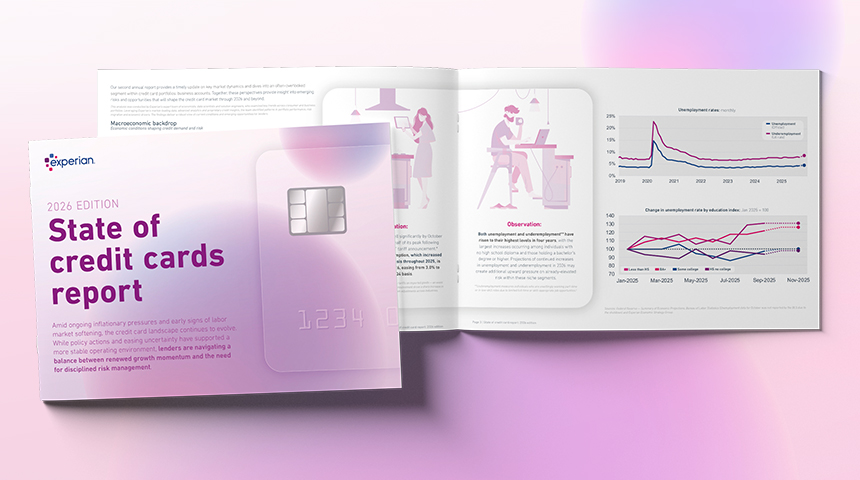
Growth, risk and the rise of "hidden" business accounts As inflation remains elevated and early signs of labor market cooling emerge, the credit card landscape is entering its next phase. Over the past few weeks, policy actions and discussions around potential interest-rate caps have driven increased uncertainty across the credit card industry and broader global markets. Lenders face a careful balancing act: capturing growth opportunities while maintaining disciplined risk oversight. Our second annual State of Credit Cards Report explores the macroeconomic forces influencing the market, key shifts in originations and delinquency trends, and lender mix. New this year, the report also digs into an often‑overlooked segment: business accounts hidden inside consumer credit card portfolios. Additionally, the report offers actionable strategies to help lenders segment risk and drive disciplined growth more effectively. Key insights include: 30+ DPD delinquency rates remained above pre-pandemic levels in 2025, underscoring the need for disciplined asset‑quality monitoring. Fintechs continue to gain ground, posting a 71% YOY increase in account originations. Business accounts masked in the consumer credit card universe represent roughly 14% of balances and are more than 50% larger than the business card universe — a material segment with distinct risk and profitability dynamics that many lenders are not explicitly managing today. The report also outlines practical strategies to: Identify and segment business behavior within consumer portfolios. Align underwriting and account management with actual usage patterns. Capture targeted growth while protecting long‑term portfolio performance. Ready to dive deeper? Download the full 2026 State of Credit Cards Report to uncover insights that can help your organization manage risk more precisely and grow with confidence. Download report

Early warning signs: Are you prepared for a shift in mortgage delinquencies? As the mortgage industry enters the final quarter of 2025, signs of stress are emerging beneath what still appears, on the surface, to be a relatively stable housing market. Recent mortgage performance data indicates a notable increase in late-stage mortgage delinquencies, particularly among loans reaching 120 days past due (DPD)—a critical inflection point in the credit lifecycle that often precedes more serious default outcomes. (Smith, 2025) While early-stage delinquencies (30 DPD) have remained volatile but directionally flat, the acceleration observed in later-stage delinquency signals a more concerning trend: a growing cohort of borrowers is struggling to recover once they fall behind. Historically, sustained increases at the 120-day mark have been a leading indicator of elevated 180-day delinquencies and higher foreclosure activity in subsequent quarters. (Smith, 2025) For lenders and servicers, this shift highlights the importance of taking action before risk becomes fully realized. A tale of two products: mortgages vs. HELOCs Interestingly, this deterioration is not evenly distributed across product types. Home equity lines of credit (HELOCs) have continued to show relative stability, with both early- and late-stage delinquency rates holding steady through mid-2025. This resilience likely results in stronger borrower equity positions, more conservative underwriting, and greater borrower flexibility in managing revolving credit obligations. However, stability should not be mistaken for immunity. Elevated consumer debt, persistent inflationary pressures, and the resumption of certain deferred obligations (including student loans) could introduce risk into home equity portfolios with little advance notice. The divergence between first-lien mortgage performance and HELOCs reinforces a critical reality: portfolio risk is no longer uniform. Mortgage risk is increasingly segmented Today’s risk environment demands more granular analysis. Borrower performance varies significantly based on loan vintage, equity position, income volatility, and broader household debt burdens. Late-stage mortgage delinquency growth is particularly concentrated among specific borrower segments rather than broadly distributed across portfolios. This fragmentation means lenders can no longer rely solely on aggregate delinquency metrics. Instead, risk strategies can be differentiated by: Product type (first mortgage vs. HELOC) Delinquency stage (early vs. mid vs. late) Borrower behavior and payment hierarchy Local economic and labor market conditions Modern risk frameworks increasingly rely on portfolio-specific modeling, continuous monitoring, and forward-looking indicators, rather than relying on lagging performance metrics. Moving from reactive to predictive risk management In a market defined by rapid shifts, reactive servicing strategies are no longer sufficient. The most effective lenders are transitioning toward predictive risk management, using near-real-time data to identify stress earlier in the delinquency curve. Advanced risk monitoring capabilities enable lenders to: Detect emerging risk before accounts reach irreversible delinquency stages. Prioritize outreach and loss-mitigation resources more effectively. Align intervention strategies with borrower behavior and the likelihood of recovery. Targeted engagement—whether through proactive borrower communication, modified repayment options, or tailored servicing workflows—can significantly improve outcomes when applied during the mid-stage delinquency window, particularly between 60 and 120 days past due. Strategic insight: Focus on the middle of the curve Many risk strategies concentrate on two extremes: fully current accounts and severely delinquent loans. However, the greatest opportunity for loss avoidance often exists in the middle. Borrowers in the 60–120 DPD range are frequently still recoverable, especially when interventions are informed by behavioral data rather than static credit attributes. Understanding which borrowers are likely to self-cure versus those trending toward deeper delinquency allows lenders to deploy capital and servicing resources more efficiently. (Smith, 2025) A data-driven approach to mid-stage delinquency management can help lenders: Improve loan-level profitability Reduce servicing and loss-mitigation costs Limit downstream foreclosure exposure Strengthen long-term portfolio performance The bottom line The recent rise in late-stage mortgage delinquencies is not merely a short-term anomaly—it is an early warning signal. At the same time, stable HELOC performance highlights how risk dynamics can vary significantly across products and borrower segments. (Smith, 2025) As the market moves through the remainder of 2025, lenders that adopt differentiated, predictive, and data-driven risk strategies will be far better positioned to navigate volatility, protect portfolio performance, and respond decisively as conditions evolve. The question is no longer whether risk is changing, but whether your organization is equipped to identify and manage it before losses materialize. Part of the Series: New Players, New Rules: How Direct Mail Is Reshaping Mortgage and Equity Lending References Smith, J. (2025). Mortgage delinquency trends. Journal of Housing Finance, 12(3), 45-60. Doe, A. (2025). HELOC performance stability. Real Estate Economics Review, 18(2), 101-115.

A Realignment is underway The U.S. housing market is no longer waiting on the sidelines. After enduring over two years of historically high mortgage rates, the Federal Reserve began implementing rate cuts in fall 2025, with additional reductions forecast for early 2026. For lenders, this marks more than a turning point—it’s a call to action. Whether you’re targeting first-time buyers, tracking refinance-ready loans, or watching affordability trends, today’s environment demands rapid, strategic adjustments. Rate cuts are fueling renewed demand Mortgage rates, which hovered around 7% for much of the past year, have begun to ease. Even a modest drop has the potential to unlock substantial borrower interest—particularly among the 4.4 million U.S. mortgages now “ripe” for refinance. Expect a spike in both rate-and-term refinances and cash-out activity, as homeowners look to lower payments or access equity. Lenders must scale up quickly, especially around digital capacity, prescreen targeting, and streamlined closings. Affordability is still a roadblock—Especially for younger renters Despite improving borrowing conditions, affordability remains a systemic challenge. The national rent-to-income (RTI) ratio stands at 46.8%, up 7.7% since early 2023. In high-cost states like California and Massachusetts, it exceeds 56%. Experian data reveals that 62% of renters fall into the low-to-moderate income category, spending over half their income on rent. Over 50% now fall into Near Prime or Subprime credit tiers, making alternative credit data—like rental payment history—vital for inclusive underwriting. Refinance isn't the only opportunity—Target first-time buyers strategically Gen Z is now the largest segment of the rental population, and many are financially strained yet aspirational. A major opportunity exists in helping these renters transition to homeownership using expanded credit models and customized offerings. With Federal Housing Finance Agency (FHFA)-approved models like VantageScore 4.0 and FICO 10T on the horizon, lenders should explore how newer scoring frameworks and rent payment reporting can increase access to mortgage credit. Region-specific strategies are more important than ever From Miami to Minneapolis, market conditions vary drastically. Some metros, like Kansas City (+16.7%) and Louisville (+14.2%), are experiencing double-digit rent growth, while cities like Atlanta and Jacksonville are seeing declines. Lenders must tailor outreach based on local affordability trends, migration patterns, and housing supply constraints. Dynamic analytics tools—like Experian’s Ascend or Mortgage Insights Dashboard—can guide regional strategy at scale. The supply side may not keep pace Even with rate cuts stimulating demand, housing supply could remain a bottleneck. Multifamily completions are outpacing starts 1.5 to 1, and single-family construction, though recovering, remains cautious. In markets with tight supply, reduced borrowing costs may drive up prices faster than inventory can absorb, exacerbating affordability for first-time buyers. What lenders should prioritize now: Build Refinance Infrastructure: Prepare for increased volume with instant income verification tools like Experian Verify to streamline processes. Target First-Time Buyers: Use rental history, cashflow scores, and rent-to-income metrics to assess nontraditional credit applicants fairly. Get Granular with Geography: Align product offerings with local affordability, vacancy rates, and rent growth. Leverage Self-Service Prescreen Tools: Act on opportunities quickly using Experian’s agile targeting platforms. Model with New Credit Scores: Take advantage of the Experian Score Choice Bundle to test VantageScore 4.0 and FICO 2 side by side. Final Thought: The market is not rebounding—It is realigning The current housing shift is not a return to old norms—it’s the start of a redefined landscape. Lenders who act decisively, invest in technology, and prioritize inclusivity will lead the next chapter in mortgage growth. Experian is here to support you—with data, insights, and tools designed for this very moment.

In our latest Experian fireside chat, Unlocking Alternative Data for Smarter Fintech Decisions, two powerhouse voices in the industry, Ashley Knight, SVP of Product Management at Experian, and Haiyan Huang, Chief Credit Officer at Prosper Marketplace, came together for an exclusive discussion on how alternative data is transforming risk, marketing and growth strategies across the fintech space. Now available to watch on demand, the conversation reveals the data-driven innovations that are empowering fintechs to reach new markets, improve decision-making, and build more inclusive financial experiences. What you'll learn During the session, Ashley and Haiyan explored how fintech leaders are utilizing alternative data to address real-world challenges with smarter, more scalable solutions. Topics include: Identity matching redefined: Discover how Individual Taxpayer Identification Numbers (ITINs), Clarity insights, and device intelligence empower fintechs to gain a competitive edge in verifying and validating identities for thin-file or underserved applicants. Precision credit marketing: Learn how email and phone intelligence help fintechs more accurately connect with qualified consumers, driving better engagement and higher conversion rates. Enhanced risk management with real-time data: Discover how Buy Now, Pay Later (BNPL) data and open banking insights are providing fintechs with a more comprehensive view of consumer financial behavior, beyond what traditional credit scores can reveal. To understand how fintech professionals are approaching alternative data, we asked attendees to weigh in throughout the webinar. Here's what we learned: What the audience had to say Which alternative asset is most important for the underwriting of the insurance? 50% chose open banking. 38% selected behavioral/device intelligence. 12% pointed to asset ownership. Takeaway: Open banking is leading the way, but fintechs are clearly embracing a multi-dimensional data approach. 2. Are you currently using ITINs or planning to in the future? 53% said yes. 47% said no. Takeaway: The adoption of ITINs is gaining momentum, supporting efforts to expand access to underrepresented segments. 3. What’s the most compelling reason to use open banking data? 70% said to better assess risk. 10% said to say yes to more consumers. 10% said to price more effectively. 10% said to improve marketing and personalization. Takeaway: Risk assessment remains the top use case, but marketers and pricing teams are starting to take notice. Why it matters Alternative data isn’t just a trend; it’s a response to the urgent need for smarter, more inclusive lending models. As fintechs continue to grow, the ability to reach new audiences, personalize offers, and manage risk with greater accuracy is no longer a competitive advantage; it’s a requirement. Whether you're already integrating cash flow, open banking, and behavioral insights, or just beginning to explore the possibilities, this webinar offers valuable frameworks and firsthand examples from industry leaders who are putting alternative data into action. Don’t miss this opportunity to catch up on the conversation that's helping define the future of fintech innovation. Watch on-demand webinar

The U.S. housing market is no longer waiting on the sidelines. After enduring over two years of historically high mortgage rates, the Federal Reserve began implementing rate cuts in fall 2025, with additional reductions forecast for early 2026. For lenders, this marks more than a turning point—it’s a call to action. Whether you’re targeting first-time buyers, tracking refinance-ready loans, or watching affordability trends, today’s environment demands rapid, strategic adjustments. Rate cuts are fueling renewed demand Mortgage rates, which hovered around 7% for much of the past year, have begun to ease. Even a modest drop has the potential to unlock substantial borrower interest—particularly among the 4.4 million U.S. mortgages now “ripe” for refinance. Expect a spike in both rate-and-term refinances and cash-out activity, as homeowners look to lower payments or access equity. Lenders must scale up quickly, especially around digital capacity, prescreen targeting, and streamlined closings. Affordability is still a roadblock—Especially for younger renters Despite improving borrowing conditions, affordability remains a systemic challenge. The national rent-to-income (RTI) ratio stands at 46.8%, up 7.7% since early 2023. In high-cost states like California and Massachusetts, it exceeds 56%. Experian data reveals that 62% of renters fall into the low-to-moderate income category, spending over half their income on rent. Over 50% now fall into Near Prime or Subprime credit tiers, making alternative credit data—like rental payment history—vital for inclusive underwriting. Refinance isn't the only opportunity—Target first-time buyers strategically Gen Z is now the largest segment of the rental population, and many are financially strained yet aspirational. A major opportunity exists in helping these renters transition to homeownership using expanded credit models and customized offerings. With Federal Housing Finance Agency (FHFA)-approved models like VantageScore 4.0 and FICO 10T on the horizon, lenders should explore how newer scoring frameworks and rent payment reporting can increase access to mortgage credit. Region-specific strategies are more important than ever From Miami to Minneapolis, market conditions vary drastically. Some metros, like Kansas City (+16.7%) and Louisville (+14.2%), are experiencing double-digit rent growth, while cities like Atlanta and Jacksonville are seeing declines. Lenders must tailor outreach based on local affordability trends, migration patterns, and housing supply constraints. Dynamic analytics tools—like Experian’s Ascend or Mortgage Insights Dashboard—can guide regional strategy at scale. The supply side may not keep pace Even with rate cuts stimulating demand, housing supply could remain a bottleneck. Multifamily completions are outpacing starts 1.5 to 1, and single-family construction, though recovering, remains cautious. In markets with tight supply, reduced borrowing costs may drive up prices faster than inventory can absorb, exacerbating affordability for first-time buyers. What lenders should prioritize now • Build Refinance Infrastructure: Prepare for increased volume with instant income verification tools like Experian Verify to streamline processes. • Target First-Time Buyers: Use rental history, cashflow scores, and rent-to-income metrics to assess nontraditional credit applicants fairly. • Get Granular with Geography: Align product offerings with local affordability, vacancy rates, and rent growth. • Leverage Self-Service Prescreen Tools: Act on opportunities quickly using Experian’s agile targeting platforms. • Model with New Credit Scores: Take advantage of the Experian Score Choice Bundle to test VantageScore 4.0 and FICO 2 side by side. Final Thought: The market is not rebounding—It is realigning The current housing shift is not a return to old norms—it’s the start of a redefined landscape. Lenders who act decisively, invest in technology, and prioritize inclusivity will lead the next chapter in mortgage growth. Experian is here to support you—with data, insights, and tools designed for this very moment.
Every credit decision relies on data, but traditional credit information may capture only part of a consumer’s financial story. Some of that story is reflected in credit reports, the loans repaid, the cards managed, and the steady progress toward financial goals. Others live quietly in bank statements and transaction histories, like the rent paid on time, the savings set aside, and the bills managed responsibly. Yet for millions of consumers, that second story has rarely been part of the credit conversation. Expanding the credit conversation can give lenders and financial institutions an edge, helping them separate genuine risk from missed opportunity. In a lending environment defined by volatility and evolving consumer habits, having a more complete picture of each applicant can help make the difference between sustainable growth and risk management. At the same time, open-banking frameworks and consumer-permissioned data have made it possible to understand financial health more clearly than traditional models. That’s where Experian’s Credit + Cashflow Score comes in. A unified view of credit and cash flow The Credit + Cashflow Score is the first-of-its-kind model combining multiple data sources into a single score. Based on our pre-production analytics, early results demonstrate a 40% improvement in predictive accuracy compared with conventional credit models. It unites our proprietary and industry-leading credit data, alternative credit insights, 24 months of trended behavior, and consumer-permissioned cashflow information into a single score ranging from 300 to 850.* This goes beyond cashflow-augmented models that rely primarily on transaction data layered over credit files. The result is a data-rich assessment of creditworthiness that allows lenders to strengthen portfolio performance, maintain disciplined risk management, and help identify qualified borrowers that traditional credit models might overlook. Better risk control and stronger growth Today’s lending landscape is being reshaped by rising interest rates, increased capital costs, and heightened regulatory oversight. These pressures are prompting institutions to tighten underwriting standards and reassess risk strategies as they navigate an uncertain economy. At the same time, competition for qualified borrowers continues to intensify, creating pressure to drive sustainable growth without compromising credit quality. Meanwhile, on the consumer side, people are earning income through gig work or multiple income streams and using alternative financial products. According to our recent market estimates, 62 million U.S. consumers are thin-file or credit-invisible1. This is making it harder for lenders to assess true financial capacity using credit data alone. Traditional credit scores continue to remain important, but they can potentially miss key indicators of stability and affordability that appear only in transactional data. The Credit + Cashflow Score bridges that gap, helping enable lenders to expand approvals responsibly while maintaining disciplined risk management. See what's next As credit markets continue to evolve, lenders are looking for new ways to balance growth with risk. Having the whole financial picture may allow organizations to grow stronger portfolios, reach more qualified borrowers, and bring financial opportunity to more people. Partner with Experian to leverage decades of credit expertise, the nation’s largest alternative credit bureau, and industry-leading open-banking solutions to help lenders innovate responsibly. The Credit + Cashflow Score is built to deliver measurable performance lift, model transparency, and ease of integration through the Experian Ascend Platform. Learn more about the Experian Credit + Cashflow Score * New score available in pre-production for analytics 1https://www.experian.com/thought-leadership/business/the-roi-of-alternative-data

Artificial intelligence (AI) is transforming industries worldwide, and financial services are no exception. One of the most impactful applications is AI credit scoring, a modern approach that uses advanced algorithms to assess consumer creditworthiness with precision, fairness and efficiency.AI credit scoring addresses traditional limitations by introducing more advanced, data-driven techniques. Instead of relying solely on static, historical data points, AI models can process vast amounts of diverse information in real time, spotting patterns and predicting behaviors more accurately. How AI is being used in credit scoring Traditional credit scoring has long relied on structured data such as payment history, credit utilization, and length of credit history. While effective, these models can be limited in capturing a holistic view of an individual’s financial behavior. AI credit scoring expands this view by: Leveraging alternative data: AI models can analyze non-traditional data sources such as rental payments, utility bills, and even digital transaction histories, providing a broader perspective for those with limited credit history. Real-time analysis: Machine learning enables lenders to evaluate applicants faster by instantly processing large amounts of data. Pattern recognition: AI systems identify subtle behavioral and financial patterns that may indicate creditworthiness beyond what traditional models can detect. Continuous learning: Unlike static scoring systems, AI-based models may improve over time as they ingest more data and refine their predictions. Using these methods, AI credit score systems create a richer, more nuanced picture of a borrower’s financial health, making lending more inclusive and predictive. The benefits of AI credit scoring The adoption of AI in credit scoring has created significant benefits for lenders, regulators, and consumers alike: Improved accuracy: AI models draw on a broader range of data, reducing reliance on limited or outdated metrics. Financial inclusion: Millions of consumers globally remain outside the traditional credit system. AI credit scoring allows lenders to evaluate previously overlooked applicants, such as young adults, recent immigrants, or gig economy workers. By factoring in alternative data, lenders can serve historically underserved individuals. Faster and more efficient processes: AI can automate large portions of the decision-making workflow, significantly reducing the time it takes to approve applications. This means faster access to credit for consumers and reduced operational costs for lenders. Fraud detection and risk mitigation: Advanced machine learning models can detect anomalies in borrower behavior that may indicate fraud or identity theft. By flagging these risks earlier, lenders protect both themselves and their customers. Enhanced customer experience: AI-driven insights help lenders design more personalized products and repayment plans. Institutions can better understand customer needs and financial behaviors by offering tailored solutions that improve loyalty and trust. Challenges of AI in credit scoring While the promise of AI is transformative, it also brings new challenges that financial institutions must navigate carefully. Bias and fairness: AI models may inadvertently replicate biases in training data, raising concerns about fairness and equity. Transparency: Complex algorithms can be challenging to explain to regulators, lenders, and consumers, creating a "black box" perception. Data privacy: Using alternative data for credit scoring requires strict compliance with privacy regulations and consumer consent. Regulatory alignment: As AI evolves, credit scoring must comply with evolving financial and consumer protection laws. Why partner with us At Experian®, we understand that trust, accuracy, and transparency are essential in the financial ecosystem. By combining decades of expertise in credit data with AI solutions, we deliver AI credit score solutions that empower lenders to make smarter, fairer, and faster decisions. With us as your trusted partner, you can embrace AI-powered credit solutions confidently and responsibly. Global data expertise: We leverage one of the world’s most comprehensive credit databases, ensuring high-quality insights. Responsible AI: Our solutions are built with fairness, transparency, and regulatory compliance at the forefront. Proven results: We partner with financial institutions worldwide to unlock opportunities for lenders and consumers through AI-driven insights. Commitment to inclusion: Our AI credit scoring tools are designed to expand financial access for underserved communities. The rise of AI credit scoring marks a new era in financial services, where accuracy, speed, and inclusivity converge to benefit lenders and consumers alike. While challenges remain, responsible use of AI ensures that credit scoring becomes more transparent, fair, and effective. Learn more

Mid-sized banks are large enough to pursue ambitious growth strategies, like expanding loan portfolios or entering new markets, but not so large that they can withstand major credit losses without consequence. So how do lending organizations manage their credit risk strategies to grow without taking on more risk than they can handle?

Nearly 19 million U.S. households remain unbanked or credit-invisible,1 not due to a lack of financial responsibility but because traditional credit models alone may not include key financial behaviors. These individuals often save, earn and budget wisely, yet conventional scoring systems do not recognize them. We’ve recently partnered with Plaid, the trusted leader in open finance, to change that. Together, we’re putting cash flow underwriting front and center — giving lenders access to real-time, consumer-permissioned financial data that paints a fuller, more accurate picture of creditworthiness. Why cash flow data matters now In the U.S., many consumers with limited credit histories want to build their profiles but don’t know how. Cash flow underwriting bridges this gap. Cash flow insights reveal real-world financial activity — like income patterns, spending habits and account balances — in real time. This empowers lenders to make smarter, faster and more inclusive credit decisions, while helping consumers gain access to the financial services they deserve. What cash flow insights deliver By incorporating cashflow data into your decisioning strategy, you can: See beyond the score with a richer view of a consumer’s financial health. Accelerate approvals with more accurate and timely insights. Expand access to credit while strengthening portfolio diversity and reducing risk. Download our infographic to see how cash flow underwriting is reshaping lending — and how you can lead the change. Download infographic 1Mullen, C. (2024, November 13). Underbanked US population grows to 14.2%, FDIC finds. Banking Dive.

Credit decisioning has traditionally relied on static data like credit bureau scores, income statements, and past repayment history. As financial behavior becomes more dynamic and consumer expectations shift toward instant decisions, real-time data is emerging as a powerful tool in reshaping how lenders assess risk.

Experian and Plaid are teaming up to power smarter, faster, and more inclusive lending — fueled by real-time cash flow insights. The financial landscape is becoming more dynamic and digitally connected. Consumers are increasingly turning to digital platforms not only to pay bills and track spending, but to better understand their financial health, monitor their credit standing, and plan confidently for the future. This evolution presents a timely opportunity for innovation in underwriting — one that empowers consumers to take control of their financial futures and enables lenders to make faster, smarter, and more inclusive decisions. What happens when the leading global data and technology company joins forces with the largest open banking network in the world? Experian and Plaid are coming together to solve some of the most pressing challenges lenders face, bringing cash flow insights into credit decisions, seamlessly. Smarter lending: Elevating the credit decision process For lenders seeking a holistic view of borrowers to make faster, more informed decisions, this new collaboration is a game-changer. Experian and Plaid are combining real-time, unmatched cash flow data and analytics to help lenders improve decisioning, pinpoint risk precisely, and drive financial inclusion. This marks a pivotal shift in how credit is assessed, moving us toward faster, and fundamentally smarter lending decisions. This strategic collaboration delivers real-time cash flow insights in a comprehensive solution, built on core principles designed to directly enhance your lending capabilities: Speed and simplicity: Driving efficiency with seamless integration In today’s fast-paced financial landscape, efficiency in underwriting isn’t just an advantage; it’s a necessity. Our combined solution prioritizes speed and simplicity by offering easy integration through APIs. This ensures fast access to meaningful risk insights, streamlining your workflows. Imagine easily leveraging real-time cashflow risk insights directly into your existing processes for faster and smarter lending decisions. This is about delivering modern infrastructure that allows you to move at the speed of today's market, empowering your business to expand with confidence. Broader visibility: Unveiling a holistic consumer view Traditional credit scores are a reliable, crucial tool for measuring a borrower’s creditworthiness. When coupled with real-time cashflow data and risk insights, lenders are empowered with broader visibility, bringing to light a more holistic view of a borrower’s current financial reality and opportunities that may have been missed. You gain a comprehensive consumer financial picture, allowing for more precise identification of both strong financial capacity and potential risks, ultimately helping you target and acquire customers who align with your growth objectives. Smarter decisions: Enhancing models with combined intelligence The power to make truly informed decisions hinges on the quality and depth of your data. Without robust insights, risk models can be limited, impacting precision and speed. With Experian's advanced cash flow analytic capabilities and Plaid's streamlined access to real-time cash flow data via Consumer Report, you can enhance your risk assessment for smarter decisions. This synergy empowers financial institutions to expand credit access and uncover hidden risks, leading to more precise underwriting. It’s about leveraging advanced analytics in real-time to drive improved decision-making and build stronger portfolios. More inclusive lending: Expanding access, responsibly A significant challenge in lending is ensuring access for all creditworthy individuals, including those with limited traditional credit histories who may be overlooked. This represents an untapped market and a vital opportunity for responsible growth. Our solution champions more inclusive lending, enabling you to reach underserved communities and empower consumers who demonstrate strong financial capacity. This not only fosters stronger portfolios but critically helps your business grow by efficiently acquiring customers across a broader spectrum. Proven trust: Lending with confidence In the financial industry, the bedrock of any solution is trust – in the data, security, and partners. Lenders require unwavering confidence in the tools they adopt. This collaboration is built on proven trust, leveraging the reach, reliability, and security of two of the most trusted names in financial services. Experian’s expertise in credit data and consumer protection, combined with Plaid’s modern infrastructure and trusted open banking network, offers unparalleled assurance. You can securely integrate these powerful insights, knowing you are backed by industry leaders committed to best-in-class security and compliance, enabling your business to grow with confidence without compromise. Smarter lending starts now The evolution of underwriting demands a more dynamic, inclusive, and precise approach. With Experian and Plaid, you're not just adapting to change; you're leading it. Empower your organization to approve more borrowers, reduce risk more effectively, and make smarter, faster decisions for sustainable success. Ready to transform your lending strategy? Learn more about how to bring cash flow insights into your credit decisions seamlessly. Learn more

Managing credit limits effectively can be a game-changer for both consumers and financial institutions. Understanding the benefits and behaviors associated with increased credit limits helps in appreciating the long-term impacts of this strategy. Proactive credit limit management offers numerous advantages that can significantly improve financial health and stability.