Latest Posts
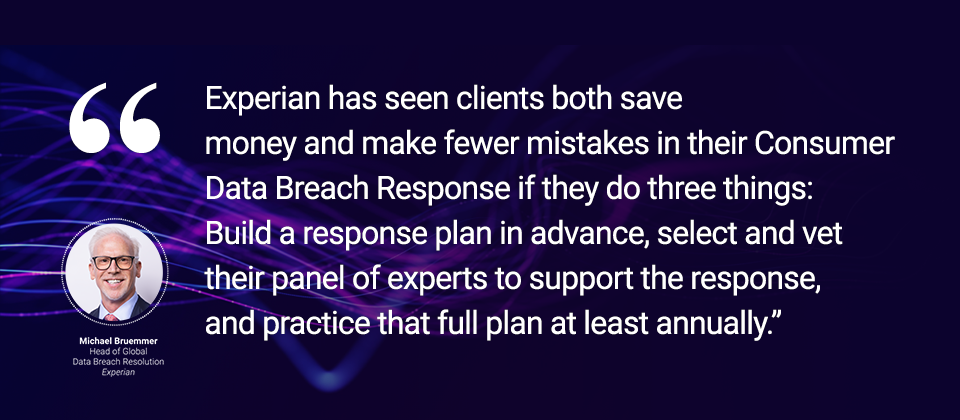
With cyber threats intensifying and data breaches rising, understanding how to respond to incidents is more important than ever. In this interview, Michael Bruemmer, Head of Global Data Breach Resolution at Experian, is joined by Matthew Meade, Chair of the Cybersecurity, Data Protection & Privacy Group at Eckert Seamans, to discuss the realities of data breach response. Their session, “Cyber Incident Response: A View from the Trenches,” brings insights from the field and offers a preview of Experian's 2025 Data Breach Industry Forecast, including the role of generative artificial intelligence (AI) in data breaches. From the surge in business email compromises (BEC) to the relentless threat of ransomware, Bruemmer and Meade dive into key issues facing organizations big and small today. Drawing from Experian's experience handling nearly 5,000 breaches this year, Bruemmer sheds light on effective response practices and reveals common pitfalls. Meade, who served as editor-in-chief for the Sedona Conference’s new Model Data Breach Notification Law, explains the implications of these regulatory updates for organizations and highlights how standardized notification practices can improve outcomes. Bruemmer and Meade’s insights offer a proactive guide to tackling tomorrow’s cyber threats, making it a must-listen for anyone aiming to stay one step ahead. Listen to the full interview for a valuable look at both the current landscape and what's next. Click here for more insight into safeguarding your organization from emerging cyber threats.

Account farming is the process of creating and cultivating multiple user accounts, often using fake or stolen identities.

In the latest episode of “The Chrisman Commentary” podcast, Experian experts explore how lenders can navigate a tight mortgage market.

Our most recent AI innovation, Experian Assistant, is redefining how financial organizations improve productivity with data-driven insights.

To ensure that advertising campaigns deliver results, automotive marketers must have a robust measurement strategy.

How can lenders ensure they’re making the most accurate and fair lending decisions? The answer lies in consistent model validations.

AI is significantly transforming the landscape of real estate fraud, enabling criminals to execute schemes like deed theft with greater ease.

Prescreen targeting solutions have evolved significantly, offering a competitive edge through more precise and impactful outreach strategies.

By implementing effective identity risk management, financial institutions can protect themselves and their consumers from identity fraud.

Summary: Gen Z, Millennials, Gen X, and Boomers each have unique automotive buying preferences and your strategies to reach each generation should reflect these preferences. The automotive landscape is shaped by the distinct preferences of different generations. From Gen Z to Boomers, each generation brings unique buying habits that automotive marketers must understand to stay competitive. Below is a brief overview of the key insights from the latest reports on Gen Z, Millennials, Gen X, and Boomers. To learn more about how to market to each generation, download the respective playbook. Gen Z (Born 1996–2015) Gen Z buyers are digital natives who prefer compact vehicles. The Honda Civic leads in market share for this group, showcasing their preference for smaller, fuel-efficient cars. They rely heavily on digital platforms for their research, with 73% of impressions delivered through Connected TV (CTV). Millennials (Born 1981–1995) Millennials value technology and eco-friendly options. Crossovers (CUVs) are their top choice, making up 50.2% of new vehicle registrations. Electric and hybrid vehicles are also popular, reflecting their environmental consciousness. Popular models include the Honda Civic and Toyota RAV4. Gen X (Born 1965–1980) Gen X buyers favor practicality and reliability, gravitating toward SUVs and trucks. The Ford F-150 is the top model among this group, and they are more likely to invest in luxury or exotic vehicles than younger generations. Boomers (Born 1946–1964) Boomers remain loyal to traditional brands, with a strong preference for non-luxury and luxury cars, such as the Honda CR-V and Ford F-150. They also favor gas-powered vehicles over electric, though hybrid options are gaining ground. Summary Understanding generational differences is crucial to developing effective marketing strategies that resonate with each group’s unique preferences. For a more detailed generational analysis, download the full report. Experian Automotive is here to help you with your marketing needs. If you’d like to learn more about our solutions and how we can support you, contact us below.

Here’s a snippet from our open banking webinar’s Q&A session with Ashley Knight, Senior Vice President of Product Management.

Mobile identity verification confirms the legitimacy of users accessing services via their mobile device.
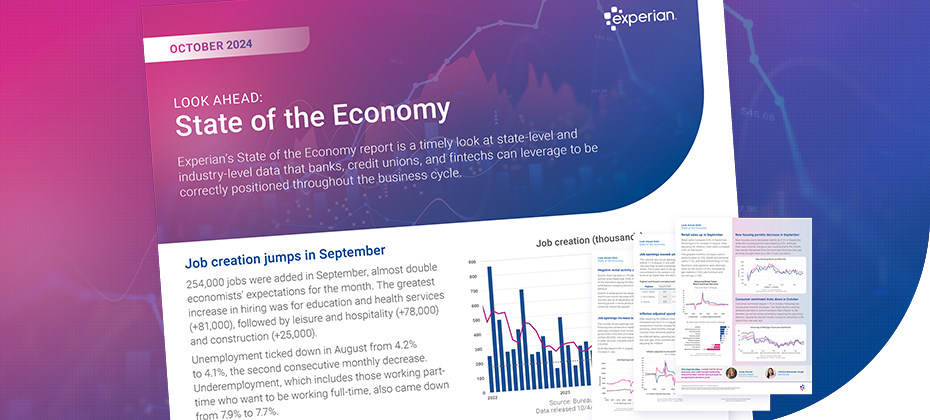
Take a deep dive into this month's economic and credit data, including trends in originations, retail sales, and consumer sentiment.

Bot attacks are plaguing financial institutions. The risks are significant, weakening both security and financial stability.

The Fed finally made their long-awaited rate cut. Hooray! The industry is saved! Brush off the dust everyone, it’s time to start originating mortgages like it’s 2006 again! Not so fast. While it's true that there are opportunities to take advantage of now that rates have declined, there remain open questions: How much further will rates decline? So far, only this single drop has been signaled. How many customers will realize benefit from a rate & term refinance offer given the rate drop(s)? What does this rate drop mean for the purchase market given that home prices remain at all-time highs? To put it simply, there are lending opportunities for home lenders (mortgage and home equity), but only for those with the ability to effectively leverage data and analytical strategies to identify and execute on the pockets of opportunity. By “pockets of opportunity,” we mean the following categories of consumers will benefit from specific mortgage or home equity offers. Rate & term refi: According to Experian research, over 83% of mortgages have an interest rate below 6.5%. This means that only the loans originated in the past couple of years (including one held by your author) will be eligible for a rate & term refi. The dollar amount on these loans will be high along with the interest rates, so even a minor savings on the interest rate will translate to potentially hundreds of thousands of dollars in lifetime interest savings for the borrowers. Being able to accurately identify which borrowers have an interest rate that is higher than the rate you can offer them is key to efficiently targeting and originating rate & term refinances. Cashout refi: Equity levels exploded over the past several years for homeowners. Home prices show no sign of slowing down and home equity continues to be a significant, and in many cases untapped, financial resource for borrowers. A cashout refi is an excellent option for those consumers with high amounts of available equity in their homes. Some borrowers may choose to originate a cashout refinance loan even if the interest rate is similar to their existing rate, such is the value of partially liquidating their equity position. Having the consumer-level data to identify what equity positions are and the current interest rate is crucial to crafting personalized, effective marketing offers. The ability to target qualified customers with a personalized offer is critical given that in August 2024, over 2.9 million cashout direct mail offers were mailed to consumers.1 Streamlined refi: The VA and FHA have streamlined refinance programs that minimize the consumer lift to refinance their loan. Additionally, there are also non-VA and FHA loans that could benefit from what is called an “Express Title,” which removes the need for a full title workup and expedites the originations process. Borrowers that meet the criteria for these streamlined refinance offers can be identified using credit data. Since these refinances are easier for consumers, they will be more likely to respond and book a refinance offer, which means more ROI for your marketing spend. Home equity lines/loans: Similar to cashout refi, home equity products are an option for consumers to access the equity they have in their price-appreciated homes. Although this is no mystery to most lenders, many lenders do not leverage adequate data or analytics to identify the needle in the haystack of customers that still remain to be targeted. Experian data shows over $25B in monthly HELOC originations as of August 2024. Understanding which consumers have a second lien position available, how much equity they have by leveraging trade-level mortgage data and Automated Valuation Model (AVM) data, and other methods can help your home equity products stand out from the sea of offers in the mail and online. At Experian, we help our clients target and originate all four categories of borrowers: rate & term refinancers, cashout refinancers, streamlined refinancers, and home equity borrowers. Crafting a marketing strategy with the accurate data to precisely identify which consumers qualify for which product is crucial to making the most of your marketing spend. Without the guidance of such data and the personalized offers they enable, your marketing message is liable to be lost among all of the other direct mail and email blasts. Market with confidence Crafting an effective holistic marketing strategy across these segments is crucial to campaign success. Consider these borrower situations and prepare to respond with confidence: Does the consumer have a high interest rate? Would the consumer benefit from a quick rate & term refi? If yes, ship the offer out. Does the consumer have a significant equity position and outstanding revolving debt balances, but not qualify for a rate & term due to a relatively low rate? If yes, ship them a cashout refi offer with language about using their equity to pay off revolving debt. Does the consumer meet the criteria for a streamlined refi, and would they benefit financially from such an offer? If yes, ship them a VA IRRRL (Interest Rate Reduction Refinance Loan), FHA streamline, or an offer to cover their refi title expenses if they qualify for an express title. Does the consumer have an open second lien on their primary residence, but not qualify for either kind of refi? If yes, ship them a home equity offer. By creating this kind of specialized marketing waterfall, lenders can ensure they have valuable offers for all borrowers, not just for a specialized market. Such strategies allow you to target your existing portfolio or a prospect population to facilitate portfolio growth and prevent portfolio attrition. Be sure to join our upcoming webinar, "Return of the Refi: Top Lending Strategies for Becoming a Refi Master." Register now and learn more about how Experian can help you win more mortgage and home equity customers in this declining rate environment. Register now Learn more 1 Mintel data