Experian is excited to introduce our new Geo-Indexed audiences. Our Geo-Indexed audiences use a new advanced indexing classification technology to identify and reach consumers based on their geo-regional attributes. These audiences can help you discover, segment, and craft messaging for consumers without the use of sensitive personal information, so you can confidently reach your target audience without sacrificing data privacy.
In this blog post, we’ll review how our new Geo-Indexed audiences can help you reach your audience while balancing data privacy and accuracy.
How we collect and use data is changing
The AdTech industry is undergoing a transformation as various forces shape its trajectory. One significant factor is legislation, with as many as 26 states currently considering data privacy laws. Consumer preferences also play a crucial role, as more individuals look to brands for responsible and ethical data handling practices. According to Forbes, 82% of people view brands positively when they consciously opt to refrain from using personal data for personalized ads. Major players in the field such as Apple and Google are actively pushing for a shift away from traditional methods like cookies and other identifiers in data collection and usage. These developments mark a considerable shift in how we use data.
Many brands are seeking a few solutions to continue to find and reach their target audience online, but at Experian, we see a great opportunity for innovation and impact within geo-based targeting solutions.
“We predict that over the next year, you will begin to see innovations in geo-based targeting methodologies that satisfy the industry’s need for audience targeting with responsible data strategies. By embracing innovations in geo-based targeting and adhering to responsible data strategies, you can not only comply with these laws but continue to reach your intended audiences effectively.”
jeremy meade, vp, marketing data & operations
Introducing Experian’s Geo-Indexed audiences
Geo-Indexed audiences from Experian allow brands to reach consumers and households based on geographic regions that over-index for a common set of attributes.
Our Geo-Indexed audiences give brands the ability to:
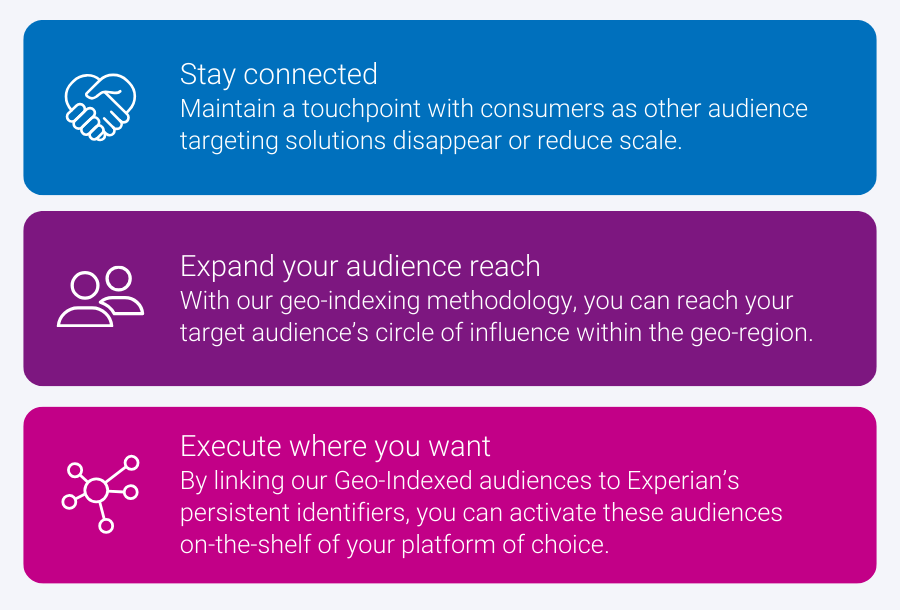
- Stay connected: Maintain a touchpoint with consumers as other audience targeting solutions disappear or reduce scale due to new legislation.
- Expand your audience reach: With our sophisticated geo-indexing methodology, you will be reaching your target audience’s circle of influence within the geo-region.
- Execute where you want: By linking our Geo-Indexed audiences to Experian’s persistent identifiers, you can activate these audiences on the shelf of your platform of choice.
As a part of the release of Geo-Indexed audiences, we will be rolling out three main categories:
- Language
- Ethnic Group
- Demographics which include:
- Education
- Household Income
- Marital Status
- Occupation
- Presence of Children
Over the next year, we will continue to release new audiences within Geo-Indexed audiences.
How you can use Geo-Indexed audiences
An Auto brand has a new corporate policy restricting the use of sensitive personal information in audience targeting but would like to reach high-income earners. To reach their target audience they use the Geo-Indexed audiences to reach households who are in geographic regions that index highly for income ranges ‘$175,000 – $199,999’ and ‘$200,000+.’
Prioritize privacy without sacrificing accuracy with Experian’s Geo-Indexed audiences
Our Geo-Indexed audiences are available in most major data and demand-side platforms. Visit our partner page for more information.
Don’t see our audiences on your platform of choice? We can help you build and activate an Experian audience on the platform of your choice.
Latest posts

Learn how Experian and Butler/Till scale local marketing across thousands of locations without losing brand consistency.

See how AdRoll and Experian combine audience data, identity, and CTV measurement to help marketers reach, prove, and grow their funnel.

Buyers can now put Experian’s audience and contextual intelligence to work in Google Ad Manager Curation in two ways: through off-the-shelf solutions available directly in Google Ad Manager, or through Custom Curation packages that Experian builds using Google Ad Manager’s inventory supply. Together, these options bring Experian’s consumer data foundation closer to the Google supply agencies already buy, with the flexibility to choose between a ready-to-use solution and an Experian package tailored to specific campaign goals. Why targeting at the source matters Many audience strategies still apply targeting on the buy side, which means signals pass through multiple systems before an impression is evaluated. Each step can shrink the pool of requests where the audience is still recognizable, so a carefully built strategy can reach the auction at a fraction of the scale it started with. Google Ad Manager Curation moves segment evaluation closer to the ad request. When a request matches the selected Experian segment, Ad Manager sends the bid request with the associated Deal ID to the buyer’s DSP. This more direct path can support stronger match and deal-transaction rates, more accurate forecasting, and better access to the audience defined in the strategy. As AI shapes more media decisions, the quality and provenance of the data feeding those systems matter more. Evaluating audience or contextual criteria closer to the source helps preserve the connection between the strategy and the impression being considered. Two ways to get started The right entry point depends on how much customization the campaign requires. Buyers can access Experian solutions off-the-shelf directly in Google Ad Manager or work with Experian to build a Custom Curation package using Google Ad Manager inventory supply. Start off-the-shelf For buyers who want direct, self-service access to Experian audience and contextual solutions. Experian solutions are available off-the-shelf in Google Ad Manager, giving buyers a straightforward way to select the data or contextual strategy that fits their campaign and create packages through Google Ad Manager’s Curation capabilities. Experian Audiences Experian Audiences draw on a deterministic offline identity foundation that represents more than 250 million U.S. consumers and 126 million U.S. households. Buyers can choose from Experian’s Audiences spanning demographics, lifestyle, financial signals, media habits, and household characteristics. That depth adds real-world consumer context beyond digital behavior alone. Contextual Experian contextual solutions give buyers a way to reach relevant environments without relying on identity. Buyers can select contextual audiences aligned to specific interests, categories, and content to inform where media appears. Experian also offers Predictive Indexed, which uses Experian audiences to predict the contextual categories and pages to target based on the likelihood that consumers visiting those environments fall within the selected audience. This gives buyers an audience-informed way to approach contextual activation without requiring identity at the point of activation. Build a Custom Curation package For buyers who need a strategy tailored to specific audience, contextual, and inventory requirements. Experian can build Custom Curation packages using Google Ad Manager’s inventory supply based on the targeting criteria that matter for a campaign. Where off-the-shelf solutions draw on Experian data, custom packages can also incorporate partner audiences and a brand’s own first-party audiences. Packages can combine Experian audiences, partner audiences, a brand’s own first-party audiences, contextual signals, and inventory or site criteria. Experian applies those criteria against Google Ad Manager inventory supply and brings the data, targeting, and inventory together into a single curated deal. This gives buyers a way to combine audience and supply decisions rather than managing each component separately. The approach can be tailored to the campaign. A buyer might start with a defined audience and add contextual or inventory criteria, bring a brand’s established first-party audience into the strategy, or build around specific supply and audience-quality requirements. Choose the path that fits the campaign Both paths do the same underlying thing: they move the audience or contextual decision closer to the ad request, before signal loss builds across the path. Whether a campaign calls for something ready to use or a package built to spec, the result is a more direct line from strategy to impression. Ready to get started? Explore Experian solutions available off-the-shelf in Google Ad Manager or contact your Experian representative to request a Custom Curation package. Latest posts