
 Edited by Michelle Tipsword
Fraud Alert vs. Credit Freeze: Key Differences Explained
Edited by Michelle Tipsword
Quick Answer
A fraud alert instructs lenders to verify your identity before approving credit, while a credit freeze restricts access to your credit report. Both are free and can protect against identity theft, but they work differently and fit different needs.

A fraud alert instructs creditors to verify your identity when processing new credit applications, while a credit freeze limits access to your credit report. You have the right to set up both fraud alerts and credit freezes. Both are free tools that help protect against identity theft, but a credit freeze requires a bit more management on your part. Here's a closer look at the differences between fraud alerts and credit freezes, when to use each, and how to set up or remove them.
| Fraud Alert | Credit Freeze | |
|---|---|---|
| What it is | Instructs creditors to verify your identity before opening credit in your name | Limits access to credit report, which can help prevent others from opening new accounts in your name |
| Best for | Someone who wants added protection with minimal disruption | Someone who wants stronger protection against new-account fraud |
| Cost | Free | Free |
| Duration | One year for initial or active-duty fraud alert; seven years for extended fraud alert | Indefinite until you remove it |
| Can it be renewed? | Yes | Yes |
| How to set it up | Online, by phone or by mail; the other credit bureaus will be notified when a fraud alert is set up at one bureau | Online, by phone or by mail; all three major credit bureaus must be notified separately |
What Is a Fraud Alert?
A fraud alert instructs creditors who view your credit report to take extra steps to verify your identification before approving new credit in your name. Placing a fraud alert can help protect against fraudulent new accounts being opened in your name.
There are three kinds of fraud alerts:
- Initial fraud alert: You can use this type of alert whenever you want, for any reason. It expires after one year unless you renew it.
- Active-duty alert: Active-duty service members can set up this type of alert when they're deployed. An active-duty alert lasts one year and can be renewed as often as needed during deployment.
- Extended fraud alert: If you've reported credit fraud or identity theft to the authorities, you can request an extended fraud alert, which lasts for seven years. You must submit a law enforcement report or an identity theft report from the Federal Trade Commission to qualify.
Fraud alerts don't prevent creditors from accessing your credit report; they simply tell creditors to take additional steps to verify your identity. Placing a fraud alert is free and does not affect your credit scores.
Setting up a fraud alert at any one of the three major credit bureaus (Experian, TransUnion or Equifax) automatically adds the alert to your credit reports at the other bureaus.
Be aware: Both credit freezes and fraud alerts help protect against fraudulent credit accounts being opened in your name, but they don't protect your existing accounts or prevent fraud that doesn't require a credit check. You'll still need to monitor your credit reports and financial accounts for signs of fraud.
How to Set Up a Fraud Alert
Here's how to place a fraud alert on your Experian credit report.
- Visit the Experian Fraud Alert Center and choose the kind of alert you want.
- Follow the instructions for uploading or mailing in copies of your ID, proof of address and any other required documentation.
Placing a fraud alert online or in the Experian mobile app is the easiest option, but you can also request a fraud alert by mail or by calling 888-397-3742.
When to Lift or Remove a Fraud Alert
You may want to remove a fraud alert if:
- You're no longer worried about fraud risk.
- You're rate shopping for credit and want to avoid delays.
- You've decided to add a security freeze to your credit report instead.
Lifting a fraud alert requires contacting each credit bureau individually. You can lift your Experian fraud alert online at the Experian Fraud Alert Center, by mail or by calling 888-397-3742.
You also can let a fraud alert expire on its own—after one year for an initial fraud alert or active-duty alert, and after seven years for an extended fraud alert.
What Is a Credit Freeze?
A credit freeze, or security freeze, limits lenders from accessing your credit report to open new credit accounts in your name. You have the right to place a security freeze on your credit report at any time. Doing so is free and won't affect your credit scores or your existing credit accounts.
Although a security freeze limits access to your credit report, it doesn't prevent everyone from looking at it. You can view your own credit report during a freeze, and so can:
- Current lenders and card issuers that run credit checks as part of managing your account
- Credit card issuers that have prescreened you for credit offers
- Landlords and rental agencies reviewing your rental application
- Prospective employers that you've authorized to conduct a background check
- Debt collectors pursuing a payment
- Child support agencies
- Government agencies carrying out court orders or warrants
You can also temporarily remove, or "thaw," a credit freeze if you're planning to apply for credit.
How to Freeze Your Credit
Follow these steps to freeze your credit with Experian:
- Sign up for a free Experian account or sign in to your existing account online or in the Experian mobile app.
- You'll see the option to set up a security freeze to limit access to your Experian credit report. Toggle the button to freeze your credit.
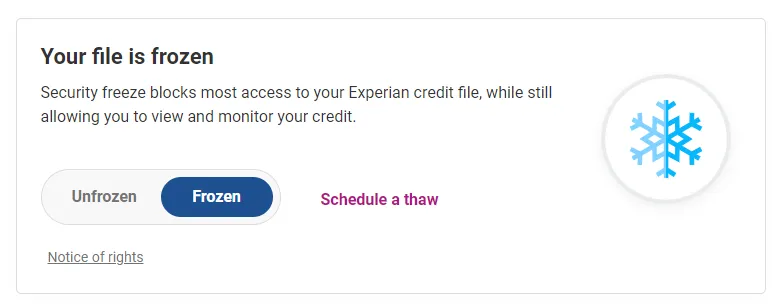
Tip: Freezing your credit with one credit bureau does not automatically freeze it with the others. You'll need to contact each of the three major credit bureaus separately and follow their process to request a security freeze.
Learn more: How to Freeze Your Credit at All 3 Credit Bureaus
When to Unfreeze Your Credit
You'll need to unfreeze, or "thaw," your credit whenever you're applying for new credit, such as credit cards or loans, or planning to get preapproved for a mortgage or auto loan.
Temporarily unfreezing your credit allows the lender to conduct a credit check, then automatically resumes the credit freeze when your scheduled thaw ends.
To temporarily thaw your Experian credit report:
- Log in to your existing Experian account or register for a new one.
- Click on "Schedule a thaw," and then "Add a thaw."
- Select a start and end date for your temporary lift and click on "Schedule thaw."
You can also permanently unfreeze your credit report whenever you want by logging in to your Experian account and toggling off the freeze.
You can lift a security freeze online, by phone or by mail. You'll need to contact each credit bureau separately to lift a security freeze. If you request an unfreeze online or by phone, the credit bureau must unfreeze your credit report within one hour. For mailed requests, the freeze must take effect within three business days of receiving the request.
Learn more: Warning Signs of Identity Theft
Should You Use a Fraud Alert or a Credit Freeze?
Some situations might call for a fraud alert, while others might be better handled with a credit freeze.
When to Use a Fraud Alert
- You suspect your information has been exposed. If your personal information has been compromised, such as in a data breach, but you haven't been the victim of a crime, consider setting up an initial fraud alert.
- You plan to apply for credit in the near future. If you expect to apply for an auto loan, mortgage or credit card within the next year, it may be easier to activate a fraud alert than to keep freezing and thawing your credit.
- You expect to move or apply for a new job soon. Credit checks may be required when you apply for a new job or apartment. Setting a fraud alert can be more convenient than remembering to unfreeze and freeze your credit repeatedly.
When to Use a Credit Freeze
- You've been a victim of identity theft. You may prefer the added security of a credit freeze in this situation.
- Your information was compromised by a data breach. Even if you haven't been a victim of fraud yet, you may want to take extra precautions by freezing your credit.
- You don't expect to apply for new credit in the near future. If you have no plans to apply for a new credit card or loan soon, a credit freeze can be a good choice. However, you'll need to thaw your credit reports if non-lenders like cellphone and internet service providers need to conduct credit checks.
Take Steps to Protect Your Credit
Fraud alerts and credit freezes are both useful tools to protect yourself against credit fraud and identity theft. But even with a credit freeze or fraud alert in place, it's important to keep an eye on your existing financial accounts and credit report.
Free credit monitoring from Experian is a convenient way to stay on top of your credit. You'll get alerts about changes to your Experian credit report, new inquiries and other activities that could signal fraud.
Monitor your credit for free
Credit monitoring can help you detect possible identity fraud, and can prevent surprises when you apply for credit. Get daily notifications when changes are detected.
Get free monitoring
About the author

Karen Axelton
Karen Axelton is Experian’s in-house senior personal finance writer. She has over 20 years of experience as a journalist and has written or ghostwritten content for a variety of financial services companies.
Read more from Karen